
Surgery can be stressful for both cats and their families. After an operation, your cat may be sleepy, less active, have a reduced appetite, or behave differently while recovering from anesthesia and the procedure itself.
The most important part of postoperative care is following your veterinarian’s instructions. Your cat may need prescription medications, restricted activity, wound care, dietary adjustments, and follow-up examinations depending on the type of surgery.
Some pet parents also consider nutritional supplements as part of their cat’s recovery routine. However, supplements are not a substitute for veterinary treatment, and some products or ingredients may not be appropriate immediately after surgery.
At Wapiti Labs, we offer nutritional products formulated for companion animals, including specialized supplements for cats. Here’s what pet parents should know about supporting a cat after surgery.
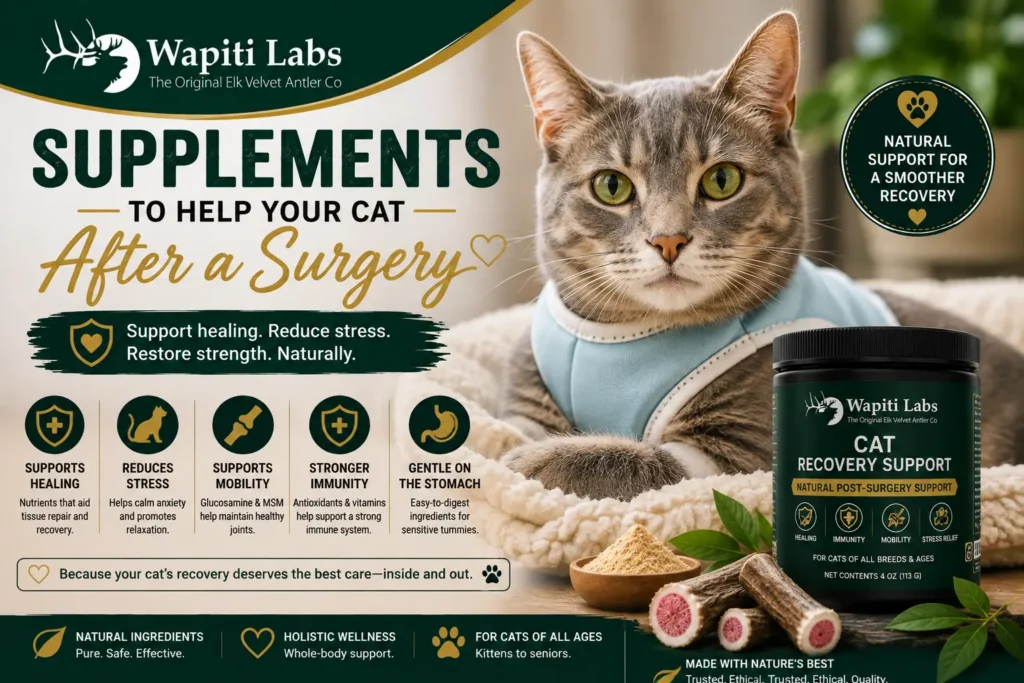
Every surgical recovery is different. Your veterinarian should provide specific instructions based on your cat’s procedure, age, health, medications, and recovery progress.
Generally, postoperative care may include:
Your veterinarian can also tell you whether a supplement is appropriate and when it can safely be introduced.
Wapiti Labs Vital Pet Supplement for Cats is formulated with elk velvet antler and selected traditional herbal ingredients.
The formula includes ingredients such as:
The product is intended to provide nutritional support for areas including normal immune function, joint flexibility, mobility, liver and kidney function, and overall wellness.
For a cat recovering from surgery, however, the appropriate timing of any supplement should be determined with your veterinarian. Postoperative cats may be taking medications or following dietary restrictions that need to be considered before adding anything new to their routine.
Learn more about Wapiti Labs’ supplements for cats.
Recovery following surgery can involve temporary changes in appetite, activity, comfort, and normal behavior.
Wapiti Labs Recuperate Herbal Supplement for Cats contains ingredients traditionally used in herbal wellness practices, including:
The formula is designed to provide nutritional support during periods of recovery and help maintain normal wellness.
The appropriate timing depends on the individual cat and the type of procedure performed.
Rather than automatically starting a supplement immediately after surgery, contact your veterinarian and Wapiti Labs for product-specific guidance regarding when it may be appropriate.
This is especially important if your cat is receiving pain medication, antibiotics, sedatives, or other postoperative treatments.
Digestive changes can occur after anesthesia, surgery, stress, or changes in diet.
Some cats may temporarily experience:
Wapiti Labs GI Tract Herbal Supplement Formula for Cats contains selected herbal ingredients, including Agastache herb, Mentha herb, and coix seed.
The formula is designed to support normal digestive and bowel function and overall gastrointestinal wellness.
However, vomiting or a prolonged refusal to eat after surgery should not simply be treated with a supplement. These symptoms can sometimes indicate a postoperative complication and should be discussed with your veterinarian.
Supplements are only one potential part of a recovery plan. Your everyday care can be equally important.
Create a comfortable area away from excessive noise, children, and other pets.
Your cat should have easy access to:
Follow your veterinarian’s instructions regarding confinement and activity restrictions.
Check the incision as directed by your veterinarian.
Contact your veterinary team if you notice concerning changes such as significant swelling, persistent bleeding, discharge, opening of the incision, or excessive redness.
Prevent your cat from licking or chewing the surgical site if your veterinarian has recommended an Elizabethan collar or other protective device.
Never change, stop, or add medication without speaking with your veterinarian.
Some supplements can interact with medications or may not be appropriate for cats recovering from certain procedures.
Your veterinarian may recommend a specific postoperative diet.
If your cat has little interest in food, ask your veterinary team for guidance rather than experimenting with multiple foods or supplements.
Some cats may have reduced appetite for a short period after anesthesia or surgery.
However, cats should not go without food for prolonged periods because inadequate nutrition can become a serious concern, particularly in overweight cats.
If your cat refuses food, repeatedly vomits, cannot keep water down, appears extremely weak, or behaves abnormally, contact your veterinarian promptly.
Your veterinarian may recommend an appropriate feeding strategy, medication, appetite support, or additional examination depending on the situation.
Supplements may provide nutritional support in some circumstances, but there is no single supplement that is appropriate for every recovering cat.
The type of surgery matters. So do your cat’s:
For these reasons, always discuss supplements with your veterinarian before introducing them after surgery.
If your veterinarian agrees that supplementation is appropriate, look for products specifically formulated for cats.
Cats have unique nutritional requirements. Avoid assuming that a supplement made for humans or another animal is appropriate for your cat.
Choose products that clearly identify their ingredients and provide appropriate directions.
The safest time to introduce a supplement varies according to the procedure and your cat’s recovery.
Your veterinarian should know about all supplements, medications, and nutritional products your cat receives.
Wapiti Labs develops nutritional products for companion animals using ingredients such as elk velvet antler and traditional herbal ingredients.
Our cat supplements are formulated specifically for feline use and are available for different wellness needs.
If your cat is recovering from surgery and you’re considering supplementation, speak with your veterinarian first and follow their recommendations regarding product selection and timing.
You can also explore Wapiti Products to learn more about the complete range of products available from Wapiti Labs.
Wapiti Labs offers products for cats, dogs, horses, and people.
Explore:
Follow your veterinarian’s postoperative instructions regarding food, water, medication, activity, and wound care. Your cat may need a specific diet or prescription medication depending on the procedure. Don’t introduce a new supplement without first asking your veterinarian.
Some supplements may provide nutritional support during recovery, but they aren’t appropriate for every cat or every type of surgery. Your veterinarian can determine whether supplementation is suitable based on your cat’s procedure, health, medications, and recovery.
There is no universal waiting period. The appropriate timing depends on the surgery, medications, recovery progress, and specific supplement. Always ask your veterinarian before starting a supplement after surgery.
A temporary reduction in appetite can occur after anesthesia, but prolonged refusal to eat should be taken seriously. Contact your veterinarian for guidance, especially if your cat is also vomiting, extremely weak, dehydrated, or behaving unusually.
Contact your veterinarian if you notice significant bleeding, increasing swelling, discharge from the incision, an opening surgical wound, severe lethargy, repeated vomiting, difficulty breathing, severe pain, inability to urinate, or other significant changes. If your cat has severe breathing difficulty, collapse, or another life-threatening symptom, seek emergency veterinary care immediately.
A successful recovery starts with appropriate veterinary care. Keep your cat comfortable, follow medication and activity instructions, monitor the surgical site, and watch closely for changes in appetite, behavior, hydration, and overall condition.
Nutritional supplements may be useful in selected situations, but post-surgical supplementation should always be discussed with your veterinarian first.
For more information about feline nutritional products, visit Wapiti Labs or explore our supplements for cats.


Phonetic spelling: wap-i-ti
Shawnee to describe large, white, rumped deer, elk