
Elk antler velvet has a long history of traditional use, particularly in East Asian and Russian traditions. Unlike mature antlers, elk velvet antler refers to the soft, growing tissue that covers an antler during its early development. This tissue contains cartilage, blood vessels, connective tissue, and a variety of naturally occurring compounds.
Today, elk velvet antler is available as a dietary supplement for people and as an ingredient in products designed for companion animals. At Wapiti Labs, elk velvet antler is an important part of our approach to natural wellness. Explore the Wapiti Labs and learn more about our range of elk velvet products and supplements.
It is important to distinguish traditional use from modern scientific evidence. Elk velvet antler has been studied for a variety of potential applications, but research is still developing, and dietary supplements should not be considered replacements for professional medical or veterinary care.
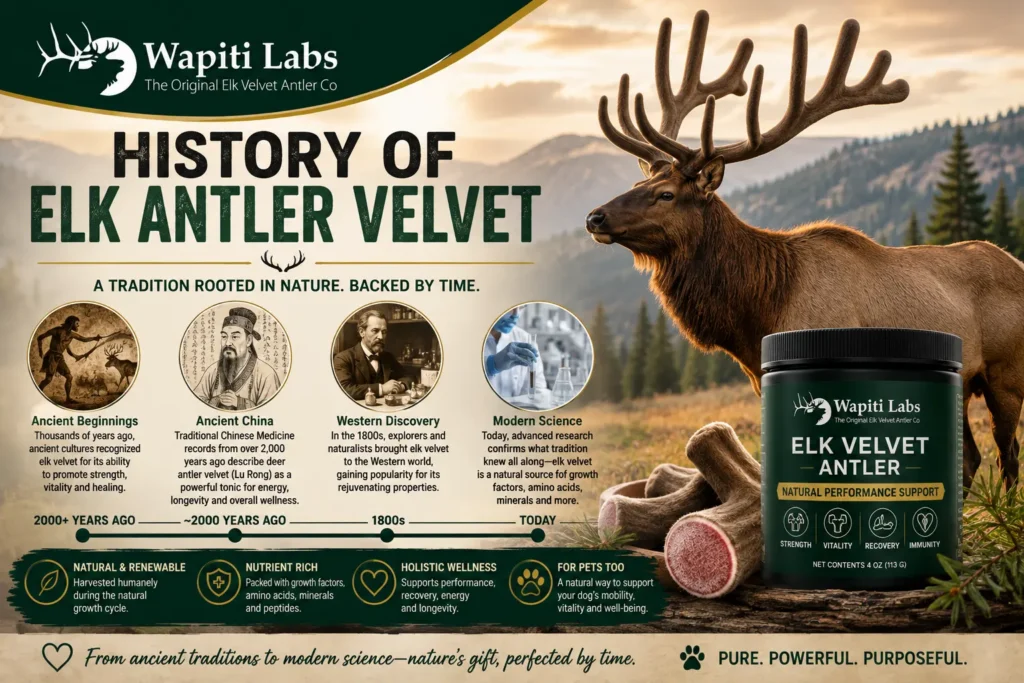
Elk antler velvet is the living, rapidly growing tissue that surrounds an elk antler while it is developing. During this stage, the antler contains blood vessels and connective tissue that supply nutrients to the rapidly growing structure.
As the antler matures, the velvet gradually disappears and the antler becomes hard bone. Male elk naturally shed their mature antlers each year and grow a new set during the following season.
This natural growth cycle is one reason elk antlers have attracted interest for centuries. Traditional cultures developed methods for using velvet antler in wellness preparations, while modern manufacturers use carefully processed velvet antler in dietary supplements.
The history of velvet antler is closely connected to traditional medicine in parts of Asia and Eastern Europe. Historical references describe its use in traditional preparations intended to support general vitality and wellness.
Rather than viewing these historical uses as proof that velvet antler can treat specific diseases, it is more accurate to understand them as evidence of the ingredient’s long-standing cultural importance.
Velvet antler has been included in traditional Chinese medicine for centuries. Historical Chinese medical texts and traditional formulations reference deer-family antler products as ingredients used in various wellness preparations.
Velvet antler was traditionally associated with concepts such as vitality, strength, and maintaining balance within the body. It was often combined with other traditional ingredients, including herbs such as ginseng.
Today, consumers interested in traditional wellness can explore Wapiti Labs supplements for people to learn more about products incorporating natural ingredients.
Traditional Chinese medicine has a long history of using animal- and plant-derived ingredients together in carefully developed formulas. Velvet antler became one of the recognized ingredients used in these traditional preparations.
Historically, velvet antler was associated with supporting vitality and physical strength. Traditional practitioners also used it in formulas intended to support overall wellness.
These historical traditions provide important cultural context, but they should not be confused with modern clinical evidence. The effectiveness of any supplement depends on the specific product, formulation, dosage, and individual using it.
One interesting part of the history of velvet antler is its traditional combination with ginseng.
Ginseng has also been used in traditional Asian medicine for centuries. Because both ingredients became associated with vitality and general wellness, they were sometimes incorporated into traditional formulas together.
Modern supplements may continue to combine natural ingredients based on their traditional history and intended nutritional or wellness role.
For pet owners, Wapiti Labs offers specially formulated supplements for dogs and supplements for cats that incorporate elk velvet antler with other ingredients.
Velvet antler also developed a strong history of use in Russia and other parts of Eastern Europe. Deer and elk products became increasingly important in traditional wellness practices, and interest in velvet antler continued into the modern era.
During the 20th century, researchers began examining velvet antler more systematically. Some studies explored its nutritional composition and potential biological effects.
This transition from traditional use to scientific investigation helped increase interest in velvet antler beyond the regions where it had traditionally been used.
However, individual studies should be interpreted carefully. Research involving velvet antler has varied in design, preparation, and quality, so historical claims should not automatically be treated as established medical conclusions.
One of the most significant developments in the history of elk velvet antler has been its transition from traditional preparations to commercially produced dietary supplements.
Modern processing allows velvet antler to be incorporated into different types of products, including powders, capsules, liquids, and formulas designed for animals.
Wapiti Labs has developed products using elk velvet antler for different audiences and wellness goals. You can browse the company’s Wapiti products to explore available formulations.
Several characteristics have contributed to the continued interest in elk velvet antler.
Perhaps the most important reason for its popularity is its long-standing history. Generations of traditional practitioners used velvet antler in wellness preparations, particularly in East Asian traditions.
Growing antler tissue contains a variety of naturally occurring nutrients and biological compounds. Depending on how the material is processed, supplements may contain components such as proteins, peptides, minerals, collagen-related compounds, and other naturally occurring substances.
The exact composition can vary depending on the animal, stage of antler development, processing method, and final formulation.
Modern consumers increasingly seek products that complement their overall wellness routines. Elk velvet antler has become one of the natural ingredients attracting interest from people and pet owners.
Elk velvet antler is not limited to products for people. It is also used in formulas designed for companion animals.
Wapiti Labs offers dedicated supplements for dogs and supplements for cats, formulated with ingredients selected for different wellness needs.
The use of elk velvet antler in animal wellness products has become an important part of its modern history.
Pet owners often look for nutritional supplements that can complement a balanced diet and healthy lifestyle. Wapiti Labs develops formulas for companion animals using elk velvet antler alongside other ingredients.
For canine products, visit the dog supplement collection.
For feline products, explore the cat supplement collection.
As with any dietary supplement, pet owners should consider their animal’s individual needs and consult a veterinarian when appropriate, particularly when a pet has an existing medical condition or takes medication.
The history of antler-based wellness products has also expanded into products designed for other animals.
Horse owners have their own nutritional and wellness considerations, which is why Wapiti Labs provides a dedicated selection of supplements for horses.
Choosing a supplement should always take into account the horse’s age, diet, activity level, and individual needs.
Elk antler has another modern use that is different from velvet antler supplements: elk antler chews for dogs.
These products are made from mature antler rather than the soft velvet stage. Antler chews are valued by many dog owners because they provide a long-lasting chewing option.
If you’re interested in this type of product, explore elk antler chews to learn more about the available options.
Pet owners should choose an appropriate chew based on their dog’s size and chewing habits and supervise chewing appropriately.
Today, elk velvet antler represents an interesting connection between traditional wellness practices and modern dietary supplements.
Its history demonstrates how natural ingredients can remain culturally significant over many generations while also becoming the subject of modern scientific investigation.
At the same time, it is important to maintain realistic expectations. Traditional use does not automatically establish that an ingredient can prevent, diagnose, or treat a disease. More research is needed to understand the potential effects of elk velvet antler and the differences between various preparations.
For consumers interested in elk velvet antler, product quality, sourcing, processing, labeling, and appropriate use are important considerations.
Wapiti Labs focuses on natural supplement formulas incorporating elk velvet antler and other carefully selected ingredients. Our product range is designed for different wellness needs and includes options for people as well as companion animals.
Whether you’re researching the history of elk velvet antler or looking for a product for a specific member of your family, you can start by exploring the Wapiti Labs product collection.
Our website also provides dedicated resources for:
Preparing a dog for a show involves more than teaching basic commands. Your dog should become comfortable with handling, grooming, standing calmly, walking on a lead, and being around unfamiliar people and other dogs. Begin training gradually and consider working with an experienced trainer or professional handler.
A balanced diet, regular exercise, proper grooming, and routine veterinary care can also help your dog be prepared for show environments.
The minimum age depends on the specific dog show organization and competition category. Many formal conformation competitions have puppy classes as well as classes for older dogs. Check the rules of the organization hosting the show to determine eligibility.
Before entering, make sure your dog meets the applicable registration, vaccination, and health requirements.
There is no single timeline. Basic show skills can take several weeks or months to develop, while advanced ring preparation may take considerably longer.
Dogs need time to become comfortable with standing, gaiting, examination by unfamiliar people, and the distractions of a busy show environment. Short, positive training sessions are generally more effective than forcing a dog to practice for long periods.
A first-time exhibitor may want to bring:
It’s also helpful to check the event’s rules before leaving home so you know what equipment and documentation are required.
Practice beforehand in environments with people, dogs, noises, and unfamiliar surroundings. Give your dog time to settle rather than immediately exposing them to a crowded area.
Maintain familiar routines, provide access to water, allow appropriate rest periods, and use positive reinforcement. If your dog becomes extremely anxious or shows unusual behavior, speak with your veterinarian about appropriate ways to manage stress.
The history of elk antler velvet is a fascinating journey from traditional Asian and Eastern European practices to today’s natural supplement industry. While its historical significance is well established, modern consumers should evaluate health claims carefully and use supplements as part of a broader approach to wellness.
Explore Wapiti Labs to learn more about elk velvet antler, natural supplements, and products created for people, dogs, cats, and horses.


Phonetic spelling: wap-i-ti
Shawnee to describe large, white, rumped deer, elk