
A cat’s eyes are one of its most remarkable features. Whether your feline is watching a toy move across the room, navigating furniture at night, or tracking something outside the window, vision plays an important role in how cats interact with their surroundings.
Good eye health can help cats remain comfortable, active, and confident throughout their lives. While cats have adaptations that allow them to see well in low-light conditions, they are not immune to eye disease or vision loss.
Understanding how cat vision works, recognizing potential warning signs, and scheduling regular veterinary examinations are important parts of responsible feline care.
A cat’s eyes contain many of the same basic structures found in human eyes, including the cornea, iris, pupil, lens, and retina.
The retina contains specialized light-sensitive cells called rods and cones. Rods are particularly important for vision in low-light conditions, while cones contribute to color and visual detail.
Cats also have a structure called the tapetum lucidum, a reflective layer behind the retina that helps make better use of available light. This is one reason a cat’s eyes may appear to glow when illuminated in darkness.
Cats also have a third eyelid, known as the nictitating membrane. It helps protect and lubricate the surface of the eye.
Together, these adaptations give cats excellent vision for their lifestyle, particularly when detecting movement and navigating in relatively dim environments.
Cats have excellent vision for detecting movement and seeing in low-light environments, but their eyesight is not simply “better” than human vision in every way.
A cat’s vision is particularly well adapted to hunting. Cats can detect subtle movements and judge distance when stalking prey.
However, cats generally don’t see fine details as sharply as humans do, and their color vision is more limited.
This means your cat’s visual world is different from yours rather than simply being better or worse.
Cats cannot see in complete darkness.
They do, however, have adaptations that allow them to see much better than humans when there is limited light.
Their large pupils, highly sensitive rod cells, and reflective tapetum lucidum help cats make efficient use of available light.
This ability is especially useful for cats because their ancestors and wild relatives are active during periods of low light, including dawn and dusk.
Even though cats can navigate relatively dark environments, they still need some light to see.
Outdoor cats depend heavily on their senses to navigate their environment.
Good vision can help a cat:
Vision loss can make an outdoor environment significantly more challenging and potentially dangerous.
For this reason, cats with significant vision problems may be safer indoors or in a controlled environment where hazards can be minimized. Your veterinarian can help you determine the safest lifestyle for a cat experiencing vision changes.
Indoor cats may not depend on eyesight for survival in the same way outdoor cats do, but vision remains important for their daily lives.
Cats use their eyes to:
Interactive play is also an important form of enrichment. Toys that move, chase toys, and other activities can encourage natural stalking and pouncing behaviors.
If your cat develops impaired vision, changes to the home environment can make navigation easier. Keep important resources in consistent locations and avoid unnecessary changes to furniture placement.
Healthy cat eyes are generally clear and free from significant discharge or swelling.
Changes in the appearance or function of the eyes can indicate a problem.
Potential warning signs include:
A sudden change in vision should be treated as a veterinary concern. Contact your veterinarian promptly if you notice significant changes in your cat’s eyes or ability to see.
Cats can develop a variety of eye conditions. Some may be minor and treatable, while others can threaten vision if left untreated.
Glaucoma involves increased pressure inside the eye and can cause pain and vision loss. Veterinary evaluation is important because untreated glaucoma can result in permanent damage.
A cataract causes the lens of the eye to become cloudy. Depending on its severity and underlying cause, cataracts may interfere with vision.
Conjunctivitis involves inflammation of the conjunctiva, the tissue surrounding the eye. Cats may develop redness, discharge, squinting, or increased blinking.
The cornea is the transparent outer surface of the eye. Scratches, ulcers, trauma, and other injuries can affect the cornea and may require prompt veterinary treatment.
Watery eyes or discharge can have several causes, including irritation, infection, allergies, blocked tear ducts, or other eye conditions.
Because different eye problems can produce similar symptoms, a veterinarian should diagnose the underlying cause rather than relying on home treatment.
Vision loss can have many possible causes, and the underlying problem isn’t always located directly in the eye.
Potential causes include:
Some causes of vision loss can be treated or managed when identified early.
That’s why regular veterinary examinations are particularly important as cats get older.
There isn’t a single way to prevent every eye problem, but several habits can support your cat’s overall health and help identify problems earlier.
Regular examinations allow your veterinarian to check your cat’s eyes and overall health.
Older cats or cats with known health concerns may need more frequent monitoring.
Remove sharp objects and potentially harmful chemicals from areas your cat can access.
If your cat has reduced vision, keeping furniture and important resources in consistent locations can also make the home easier to navigate.
Nutrition plays an important role in overall feline health. Feed a complete and balanced diet appropriate for your cat’s life stage and individual needs.
You know your cat’s normal behavior better than anyone. Changes such as reluctance to jump, bumping into objects, or becoming unusually cautious may indicate a vision problem.
Some human medications or eye products may not be appropriate for cats. Always ask your veterinarian before putting any medication or eye product into your cat’s eyes.
Pet parents sometimes consider nutritional supplements as part of an overall wellness routine.
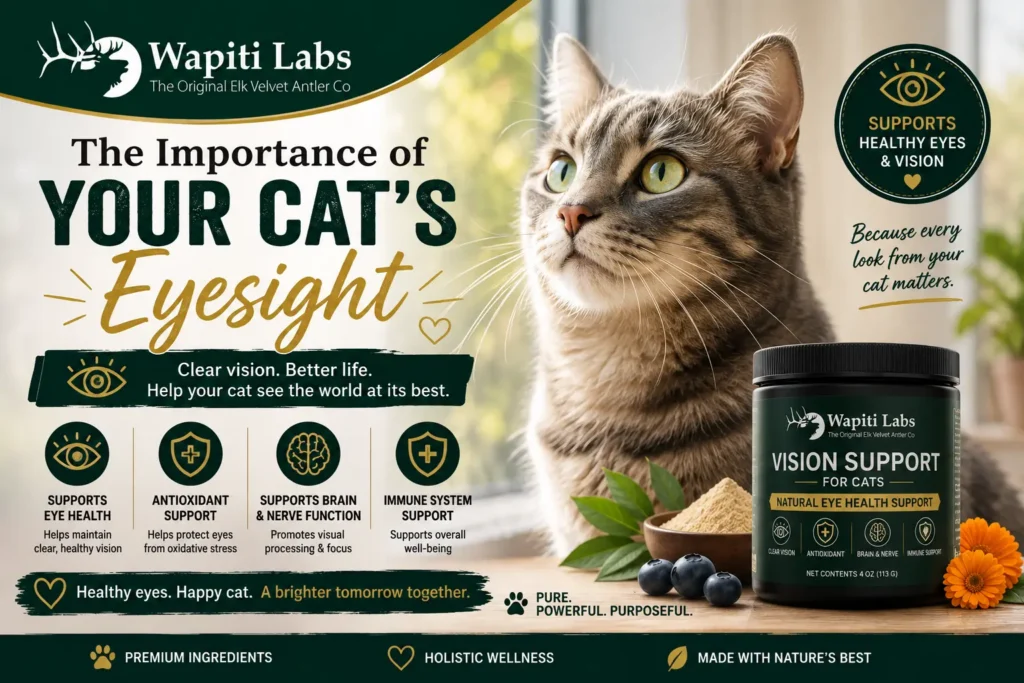
Wapiti Labs offers feline nutritional products formulated with ingredients such as elk velvet antler and traditional herbs. Our supplements for cats are designed to support different aspects of feline wellness.
However, supplements should not be considered a treatment for cataracts, glaucoma, infections, injuries, or other eye diseases.
If your cat already has an eye condition or is taking medication, speak with your veterinarian before introducing a new supplement.
Wapiti Labs Vital formula combines elk velvet antler with selected traditional herbal ingredients.
The product is intended to provide nutritional support for areas such as:
For cats with existing eye problems, however, veterinary diagnosis and treatment should always come first.
A nutritional supplement may be considered as part of an overall wellness plan when appropriate, but it should not replace professional veterinary care.
Wapiti Labs provides nutritional products for people and companion animals.
Explore the full range:
Cats have excellent vision for detecting movement and navigating in low-light conditions. Their eyes are adapted for hunting, but cats generally see less fine detail and a more limited range of colors than humans.
Cats cannot see in complete darkness, but they can see much better than humans in low-light conditions. Their large pupils, sensitive rod cells, and tapetum lucidum help them use available light efficiently.
Warning signs can include cloudy eyes, redness, discharge, squinting, excessive blinking, unequal pupils, bumping into objects, hesitation when jumping, or difficulty navigating familiar surroundings. Sudden vision changes require prompt veterinary attention.
Vision loss can result from several conditions, including glaucoma, cataracts, retinal problems, trauma, inflammation, infection, age-related changes, and certain underlying health conditions. A veterinarian should determine the cause.
Schedule routine veterinary examinations, provide a balanced diet, keep your cat’s environment safe, monitor changes in eye appearance or behavior, and seek veterinary care when you notice abnormalities. Avoid using human eye medications unless your veterinarian specifically recommends them.
Your cat’s eyesight plays an important role in how it explores, plays, hunts, and interacts with the world. Although cats have impressive adaptations for seeing in low light, they can still develop eye diseases and vision problems.
Regular veterinary care, good nutrition, a safe environment, and attention to changes in your cat’s eyes or behavior can help you identify potential problems early.
For additional feline wellness information, explore Wapiti Labs and our supplements for cats.


Phonetic spelling: wap-i-ti
Shawnee to describe large, white, rumped deer, elk